I’ve worked as a financial planner for many years, and I’ve frequently observed that many people who come to me for advice don’t have a clear picture of their financial lives. Indeed, some can’t answer certain questions about their finances, like how much they spend on a monthly basis.
People often have a very fragmented view of their finances. Obviously, they have bits and pieces: income, bills, savings or investments, and pensions. But unless they work with a professional who can create a comprehensive financial plan for them, they seldom look at the whole picture. They assume it’s going to be complicated and, in some ways, they’re right.
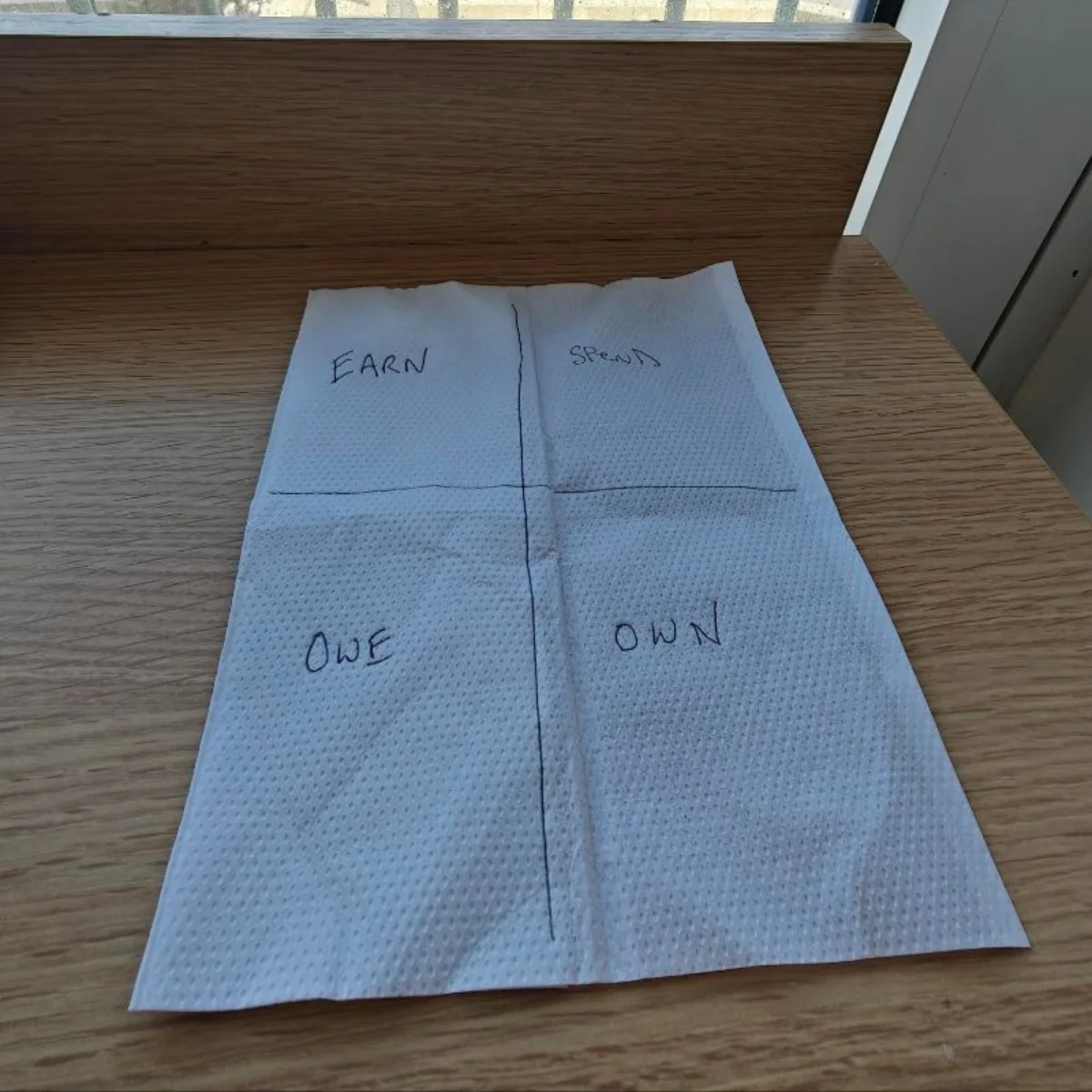
When I started working with a new client recently, I used a simple framework, literally sketched on the back of a napkin.
The reason this is possible is because the core of every financial plan, the beating heart of the whole thing, is actually incredibly simple:
- It fits on a napkin
- It fits in your head
- It fits around four words: earn, spend, own, owe.
So, to take you through the actual sketch, I would start by drawing a simple cross, creating four boxes.
- In the top left, I write ‘Earn’
- Top right: ‘Spend’
- Bottom right: ‘Own’
- Bottom left: ‘Owe’
That’s it. Four words. Four moving parts. The entire shape of a financial life.
Many will recognise this as a hybrid income statement and balance sheet.
The whole of your financial life on a napkin – and a simple rule for working out what you’ll need.
A Quick Tour of the Four
If we look at the four key elements, Earn is everything coming in: salary, dividends, rental income, pensions. It’s what funds your lifestyle today.
Spend is everything going out: the mortgage, food, heating, Amazon, holidays, nights out, the works.
Own is what you’ve built up: your home, pensions, individual savings accounts, investments, savings – everything that has value and belongs to you.
And finally, Owe is everything you’ve borrowed: mortgages, credit cards, car finance, student loans.
These are four simple ideas, but when you map them out on a napkin, the effect can be surprisingly powerful. Suddenly, you see your financial life as a whole. You can spot imbalances, patterns, and risks.
After I did the napkin exercise with this client, I offered the big reveal that shifted the conversation completely.
“When you retire, what you own will have to pay for what you spend.”
The Shift That Changes Everything
This is the moment that lands hardest because most people, for most of their lives, rely on the Earn box to pay for their Spend box. They don’t think much about the bottom two boxes – Own and Owe – because they don’t need to. As long as the income keeps coming in, everything feels manageable.
But when the work stops – or slows down – the Earn box shrinks. The Spend box doesn’t. If anything, it might get larger: travel, hobbies, helping family, health costs, inflation.
So, what’s going to fund it?
That’s the shift. The dependency moves from Earn to Own.
Your assets – pensions, savings, investments – are now responsible for delivering the income you’ll need.
If they aren’t up to the task, you have a problem.
So… How Much Is Enough?
The question that follows almost every time is, “Okay, but how much do I need?”
That’s when I introduce a simple rule of thumb. It‘s not a formula; it’s not exact, but it is memorable, and it gets people thinking in the right way.
I call it the Rule of 375.
The idea is this: to generate €1,000 per month in retirement income, you will need roughly €375,000 in capital set aside. So, if your desired retirement income is €3,000 per month (after the state pension), you’re going to need around €1.125 million.
This is based on a set of reasonable but simplified assumptions: a 4% sustainable withdrawal rate, adjustment for inflation, net of fees and taxes, starting at retirement age.*
It’s not a plan, but it certainly is an eye-opener – suddenly, people realise their retirement spending target needs to be specific.
The capital required to support that lifestyle might be higher than they thought. They now have a reason to pay attention to their Own box, and they start to ask better questions:
“How far off am I?”
“How long have I got to close the gap?”
“What am I doing today to increase what I own?”
Why This Matters
People come into financial planning conversations with fragmented ideas: questions about pensions, investments, property, stocks and shares. But when I start with a napkin and a pen and give them this framework – Earn, Spend, Own, Owe – everything starts to make sense.
When I layer in the Rule of 375, you suddenly have a way to connect the present with the future. Your money starts to have context.
That’s what you really need from me – clarity and structure.
If you’re not sure how your “Own” box lines up with the lifestyle you want later, that’s exactly what a review is for. If you’d like to talk it through, get in touch.
*The Rule of 375 is based on the “safe withdrawal rate” concept, where a retiree can sustainably withdraw 4% of their capital per year without depleting it too quickly. To generate €12,000 in a year, which is €1,000 per month, divide €12,000 by 0.04, which equals €300,000. Add a margin for taxes, fees, and a cushion against market volatility and inflation, and you arrive at a practical rule of thumb: €375,000 per €1,000 per month.
This post does not constitute Financial Advice. Pure Finance Ltd is regulated by the Central Bank of Ireland.